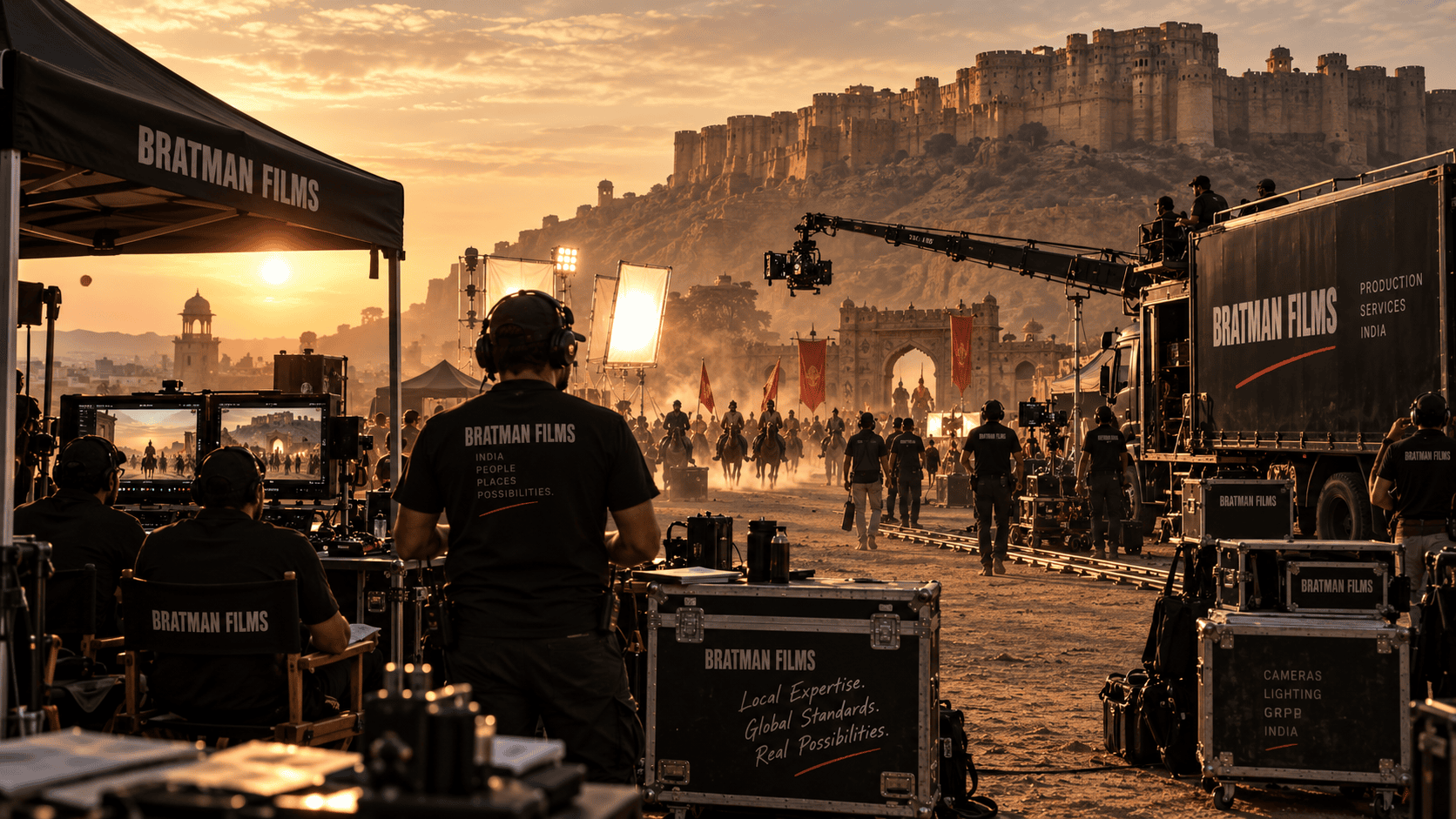
Shooting in India · a producer's guide
Mumbai, India / Worldwide
Shooting in India as a foreign crew.
The permission stack, the visa question and what timelines really look like. The honest version, from a producer who runs these shoots.
Why this page
India is generous to cameras and exacting about paperwork.
Every producer who has run a shoot in Indiagives the same answer: the country is very filmable, and the permission stack is layered rather than difficult.
This page is the coffee version, not the rate-card version. What the permission stack actually is, which visa fits which format, what timelines really look like and what a local partner carries. Rules move, so before anything is booked it is advisable to confirm current requirements on ffo.gov.in and with the Indian mission where you apply.
The permission stack
Three layers. No single stamp.
Where a production applies depends on what it is making.
- 01
The national window
The Film Facilitation Office on India Cine Hub is the Ministry of Information and Broadcasting's single window, run by the NFDC. Its scope is scripted content: features, TV and web series, reality formats. Ad films are not FFO business.
- 02
State and location
The permissions that decide a commercial shoot live lower down: municipal bodies, location owners, and specialist desks like the ASI for protected monuments or the railways for stations and track.
- 03
Police and NOCs
A day on a public street runs on local permission: the police know and the NOCs are signed. This layer moves on relationships, and it moves in parallel with everything else.
The mistake is treating single window as single stamp. The window coordinates the scripted layer. The rest of the stack is still worked desk by desk, which is what a producer on the ground is for.
The visa question
Permission first, visa second.
Ad films and commercials travel on a J visa. Features and series travel on the F film visa. Different desks, different paperwork.
For scripted work, the FFO process produces the Ministry of Information and Broadcasting permission letter, and the F visa follows it. For ad films, AV commercials and documentaries there is no central script clearance: the crew travels on J visas, approved on the Ministry of External Affairs side through the Indian mission where you apply.
Stays that run past 180 days register with the FRRO. Categories and desks change, so it is advisable to confirm current requirements with the mission, or with us, before anyone books a flight.
- J visa: ad films, AV commercials and documentaries, via External Affairs
- F visa: features, TV and web series, after Information and Broadcasting approval
- FRRO registration: only when a stay runs past 180 days
Timelines
The number everyone reaches for, and what it really means.
"Three weeks" is a quote, not a plan.
Ask around and the answer comes back fast: about three weeks. The honest version is that nobody controls the three weeks. Permissions run in parallel with recce and casting, some land in days, and a few need chasing, a holiday to pass, or a substitute location.
What a producer actually promises is the shoot date. The paperwork is built around it, with buffer living in prep and never in shoot days. The earlier a brief lands, the less the schedule has to flex.
Money
The incentive question, answered honestly.
There is a national film incentive. Commercials do not qualify.
India's headline scheme reimburses a share of qualifying spend for foreign productions: features, series and documentaries, applied through an Indian line-production company. Advertising and corporate promotional work is a named exclusion. Ad shoots take the mission/visa route, not the incentive desk.
Where ads do save money is elsewhere: government-owned locations in Maharashtra can be shot free of charge against a refundable deposit, state film cells run the permissions, and a good local producer budgets around what actually applies rather than what the brochures advertise. Scheme rules change; confirm the current position for any specific project before counting it.
What a partner carries
Every line on this page is someone's job.
Permits and local fixing, locations and recces, crew and department heads, casting, equipment and post, plus one producer accountable for all of it.
That is the job described, in service language, on our production services page.
Foreign crews
The questions crews ask first.
- Do foreign crews need permission to film in India?
- Yes, and the route depends on the format. Scripted work (features, TV and web series, reality shows) clears through the national single window: the Film Facilitation Office on India Cine Hub. Ad films and commercials are cleared at state and location level, with police and local NOCs.
- Which visa do we need to shoot an ad film in India?
- Ad films, AV commercials and documentaries travel on a J visa, approved on the Ministry of External Affairs side through the Indian mission where you apply. Features and series use the F film visa, granted after the Ministry of Information and Broadcasting approves the project. Confirm the current category before booking travel.
- What is the FFO, and do commercials use it?
- The Film Facilitation Office is the single-window clearance for scripted filming in India, run by the NFDC for the Ministry of Information and Broadcasting. It does not process ad films: a commercial's permissions live at state, location and police level.
- How long do film permits take in India?
- It depends on the location stack. Straightforward permissions can land in days; monuments, railways and sensitive sites take longer. Applications run in parallel and the slow ones get chased, which is what a local partner is for.
- Can we shoot at monuments, stations or on the street?
- Usually yes, with the right desk. Protected monuments go through the ASI, stations and track through the railways, public streets through municipal and police permissions. Each is a separate application, not one stamp.
- When should a local producer come on board?
- Earlier than feels necessary. Recce, casting and permissions start together, and the earlier the paperwork moves, the less the schedule has to flex.
Permits first.
Your next film starts here.
Send the brief. A producer comes back with a plan, a permit path and a budget that holds.